

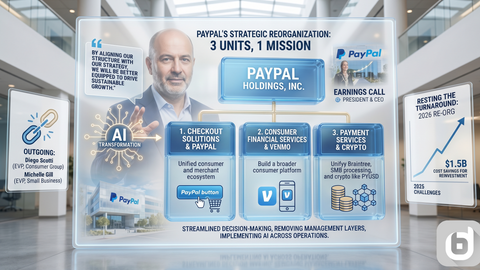
Why now is the moment
In April 2026, new CEO Enrique Lores, appointed just weeks earlier in March, announced A sweeping strategic reorganization collapsing PayPal into three focused business units to "recommit to fundamentals" and simplify how work gets done. That's a textbook air-cover event: new leadership, a new P&L structure, new accountability mandates, and a public admission that PayPal "underinvested in its technological framework for years." At the same time, the company is cutting 20% of its 23,800-person workforce, roughly 4,760 jobs, while asking the leaders who remain to deliver faster growth and better margins. For a tech vendor, that combination of technology debt, workforce reduction, and fresh executive accountability is about as high-receptivity as a buying environment gets.
The new structure: three buying centers
PayPal now runs as three distinct business units, each with its own P&L, executive owner, and pain surface (the post-reorg org chart lays this out clearly if you want the visual).

Where PayPal is struggling
Checkout underperformance is the sharpest problem. Q4 2025 branded checkout TPV grew only 1%, down from 6% the year before, and Q1 2026 came in at 2% on a currency-neutral basis. CFO Jamie Miller said the team "was too optimistic about how quickly we could drive change and customer adoption across a massive global user base." The root cause: large enterprise merchants needed far more hands-on integration support than anyone planned for, and PayPal's teams were stretched too thin to give it.
AI adoption is stuck at the pilot stage. Lores has confirmed the company has "run many pilots" but never redesigned core processes around them at scale. A new Chief AI Transformation and Simplification Officer, Anshu Bhardwaj, was brought in specifically to fix that function by function, with a $1.5 billion cost-savings target tied to AI-driven productivity.
Crypto infrastructure is a declared priority that's ahead of its plumbing. PYUSD is now in 70 markets, but PayPal's own SVP of Crypto, May Zabaneh, has acknowledged that most merchants still lack structured, machine-readable product catalogues, and the liability framework for AI-agent-initiated transactions is still unresolved.

Where PayPal is winning
Venmo still has strong brand affinity and consumer engagement, and the new Consumer Financial Services unit is chartered to turn that audience into a monetizable financial services platform. PayPal's AI-assisted developer tools already have a real proof point: a 3,000-app Java upgrade finished five times faster with AI, and leadership is targeting a 40% increase in overall engineering throughput. The PYUSD stablecoin and the Google AI Checkout partnership, which supports Google's Universal Commerce Protocol, show PayPal is actually moving on the agentic commerce front, not just talking about it.
Executives to engage

- Enrique Lores, owns the success of the three-unit model and the AI-driven reset; he's the ultimate sponsor for any enterprise-wide platform.
- Jamie Miller controls opex, transformation funding, and ROI scrutiny on new SaaS spend.
- Frank Keller needs faster experimentation, merchant innovation, and reliability.
- Alexis Sowa is accountable for Venmo monetization and the consumer product roadmap, a strong fit for CX, analytics, and engagement tech.
- Jeff Pomeroy, interim, oversees Braintree and SMB/crypto processing and cares about platform resiliency and merchant integration speed.
- Anshu Bhardwaj has the mandate to use AI to simplify operations and experiences, a natural entry point for any AI or automation platform.
- Antonio Lucio needs coherent, data-driven brand and customer journeys across all three units, a potential buyer for martech or a CDP.
- Aaron J. Webster owns AI, privacy, fraud, and the regulatory risk framework, a key stakeholder if your platform touches data or ML.
- Shaun Khalfan, the CISO, is a critical approver for any SaaS touching customer or financial data, and cares about AI risk, zero trust, and compliance.
- Srini Venkatesan is responsible for platform simplification, developer velocity, and infrastructure modernization.
What to say: opening message framework
"PayPal is executing the most ambitious reset in its history: three new business units, a 20% workforce reduction, and a CEO mandate to become an AI-first technology company. The risk is that transformation stalls because there's no scalable platform underneath the pilots. We've helped global fintech and payments companies accelerate exactly this kind of process redesign, compressing what typically takes 18 months into a single quarter. I'd like 20 minutes to show you how we've done it, and what a Q2 2026 quick-win scenario could look like for your team."
Tailor the angle by buyer. For the CEO or CFO: measurable productivity, less duplicate tooling, and ROI that ties directly to the $1.5B savings mandate. For the AI Transformation Officer or a BU GM: speed of experimentation and process redesign, the ability to run governed AI workflows without rebuilding compliance guardrails every time. For risk or the CISO: privacy by design, AI model governance, and alignment with the Enterprise AI Governance Framework and ERCM program.
Discovery questions that open the conversation
As you migrate to the three-unit model, which processes are being redesigned around AI first, and where are the bottlenecks slowing adoption? What does a "quick win" look like for your unit in Q2 2026, given this is the first full quarter under the new structure? Checkout migration is at 25% after 15 months, what's the single biggest constraint, integration capacity, merchant change management, or something else? How are you operationalizing the Enterprise AI Governance Framework so individual product teams can ship AI features without overloading central risk and compliance? And where do you still see duplicated platforms or tooling between Braintree, PayPal, and Venmo that you're being asked to rationalize under the new structure?
Timing: act before Q2 2026 earnings
The Q2 2026 earnings call, expected in August 2026, is Lores' first full-quarter proof point for the new structure. New unit presidents need wins to show the reorg is working. The window to become a quick-win vendor, and lock in preferred status before the budget review cycle closes, is open right now.
If you want sales strategies, plays, and motions tailored to your business, your solutions, and your competitive landscape, drop "PayPal" in the comments, connect with me on LinkedIn, or DM me "PayPal" or any other Fortune 1000 account name and I'll show you what it looks like for your team.
Sources:
https://about.pypl.com/who-we-are/executive-leadership/default.aspx
https://www.databahn.com/products/paypal-org-chart-and-sales-intelligence-report